The Counting Challenge
Manufacturers handling hundreds to thousands of discrete parts — across a wide size spectrum, from sub-5 mm micro-pins to 200 mm cable assemblies — face significant bottlenecks. Human counters achieve 95–97% accuracy under optimal conditions, with error rates doubling after 90 minutes of repetitive work. Miscounted shipments cause OEM assembly stoppages, expedite freight charges, and warranty exposure.
| Challenge Area | Observed Impact | Business Risk |
|---|---|---|
| Manual counting fatigue | Accuracy degrades from 97% to below 93% within one shift | Short-ship complaints, rework |
| Mixed-size batches | Small parts missed; large parts double-counted | Inventory discrepancy |
| Overlapping / touching parts | Human eye cannot reliably separate clusters at speed | Systemic undercount |
| High SKU variety | Wrong part counted as correct; mix-in undetected | Quality escape |
| No audit trail | No per-batch record of count method or verifier identity | Compliance / audit risk |
| Throughput bottleneck | Count stations limit line speed; overtime costs accumulate | COGS inflation |
Why Manual and Mechanical Methods Fall Short
The fundamental limitation of all non-vision methods is their inability to deal simultaneously with size variation, part proximity and mixed SKUs. Machine vision with instance segmentation resolves these constraints in a single imaging pass.
| Method | Limitation | Failure Condition |
|---|---|---|
| Manual visual count | 95–97% accuracy, degrades with fatigue | Any high-volume batch |
| Weight-based estimation | Part weight variation causes count drift | Mixed lots, worn parts |
| Photosensor / break-beam | Cannot distinguish touching parts | Overlapping/clustered parts |
| Mechanical vibratory counter | Works only for one SKU; costly reconfiguration | Multi-SKU batches |
| Barcode scan-and-count | Requires individual part labelling | Sub-10 mm components |
| Sampling-based QC | Misses localised short-count events | End-of-reel/bag lots |
Suggested Machine Vision Architecture
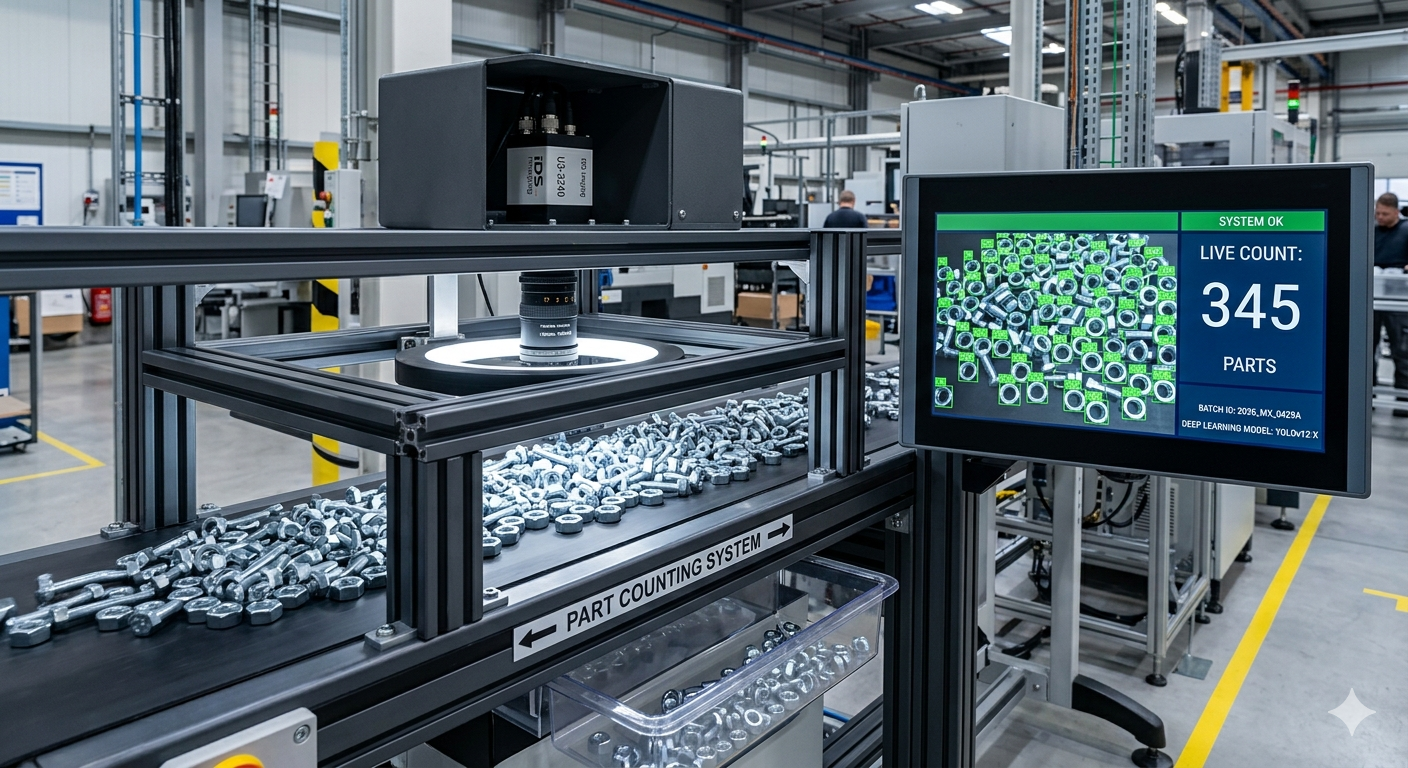
The architecture deploys a top-view area-scan camera over a backlit presentation platform with diffuse LED illumination. Parts are presented in a single spread layer; a high-resolution camera captures the full platform in one frame. A Mask R-CNN or equivalent instance segmentation model identifies and masks each individual part boundary in the image, even when parts are touching or partially overlapping. Inference completes in under 500 milliseconds on an embedded IPC.
| Counting Capability | Method | Performance | Part Size Range |
|---|---|---|---|
| Individual part detection | Instance segmentation CNN | 99.5%+ accuracy | Sub-5 mm to 200 mm+ |
| Touching / overlapping parts | Boundary separation (Mask R-CNN) | > 98% separation rate | All sizes |
| Mixed-SKU identification | Classification + geometry | > 99% part-type accuracy | All sizes |
| Short count detection | Count vs. target threshold | 100% detection | All batch sizes |
| Wrong part mix-in flag | Shape + class mismatch | > 97% detection rate | Distinct geometries |
| Cycle time per batch | Single-frame inference | < 2 seconds | Standard tray load |
Expected Outcomes & ROI
| Outcome Metric | Baseline (Manual) | Target (Vision) | Improvement |
|---|---|---|---|
| Count accuracy | 93–97% | 99.5%+ | > 60% error reduction |
| Batch count cycle time | 3–8 minutes manual | < 2 seconds automated | > 95% time saving |
| Operator headcount (counting) | 1–2 FTE per shift | 0 (oversight only) | 1–2 FTE redeployed |
| Short-shipment incidents | 2–5% of batches | < 0.1% | > 97% reduction |
| Over-pack waste | 1–3% excess per batch | Near zero | Direct material saving |
| Inventory record accuracy | 92–95% | > 99.5% | Real-time ERP sync |
| Payback period | — | Typically 10–14 months | Positive ROI |
Implementation Considerations
A phased rollout begins with a demonstration using the client's own parts within two weeks. Phase 2 deploys a benchtop station on a single line, operating parallel with manual counts over 4 weeks. Phase 3 replaces manual counting and integrates output with client ERP. Most facilities achieve full deployment within 8–10 weeks.
The full application note covers detailed system architecture, camera and lighting configuration parameters, model training methodology, integration with existing MES and ERP systems, and a step-by-step deployment checklist validated across multiple production sites.