The Traceability & Aggregation Challenge
The global pharmaceutical track-and-trace market was valued at USD 5.2 billion in 2025 and is projected to reach USD 9.4 billion by 2031 at a CAGR of 10.2%, driven by regulatory mandates in over 140 countries requiring serialized end-to-end traceability. Regulations such as the U.S. Drug Supply Chain Security Act (DSCSA) and the EU Falsified Medicines Directive (FMD) demand complete electronic pedigrees linking individual unit identifiers to their case, shipper, and pallet-level parents.
At the pallet level, aggregation is the critical last step before goods leave the facility. A 2–3% error rate in aggregation data files, while seemingly small, translates to thousands of quarantined products daily across the supply chain.
| Challenge Area | Operational Impact | Regulatory Trigger |
|---|---|---|
| Missing pallet SSCC label | Distributor cannot confirm pallet contents without breaking seals; shipment quarantined | DSCSA / GS1 SSCC standard |
| Incorrect parent–child hierarchy | Aggregation errors concealed until downstream scan; creates bottlenecks and chargebacks | DSCSA Exception handling |
| Duplicate serial numbers on pallet | Invalid EPCIS events; rejected by trading partner system or national repository | GS1 EPCIS / FMD |
| No pallet-level data to ERP/L3 | Inventory inaccurate; pallet build not recorded in serialization repository | JEKSON / MES interface |
| Manual aggregation recording | Prone to transcription errors; no real-time validation; no audit trail | 21 CFR Part 11 |
| Partial or skipped aggregation | Downstream inference fails; trading partners cannot verify without unit-level scan | DSCSA Sec. 582 |
Why Traditional Approaches Fall Short
Standalone barcode scanners without aggregation software capture scan events but cannot build or validate the hierarchy, detect duplicates, manage pallet open/close workflows, or communicate EPCIS events upstream. A purpose-built aggregation system with an integrated operator interface and upstream communication module is the only reliable path to pallet-level compliance.
| Limitation | Operational Impact | Severity |
|---|---|---|
| Paper-based / manual recording | Transcription errors in serial numbers create invalid parent–child relationships; no real-time catch | Critical |
| No duplicate detection | Same case scanned twice assigned to pallet; downstream verification fails at distributor | Critical |
| No JEKSON interface | Aggregation data not pushed to serialization repository; DSCSA compliance gap at pallet level | Critical |
| No operator HMI / exception workflow | Operators cannot resolve errors at point of aggregation; rework discovered post-shipment | High |
| No audit trail | Cannot demonstrate who performed aggregation, when, and with what result; 21 CFR Part 11 gap | High |
| Fragmented systems | Aggregation data siloed from ERP / WMS; inventory reconciliation manual and error-prone | Medium |
The Pallet Aggregation System Approach
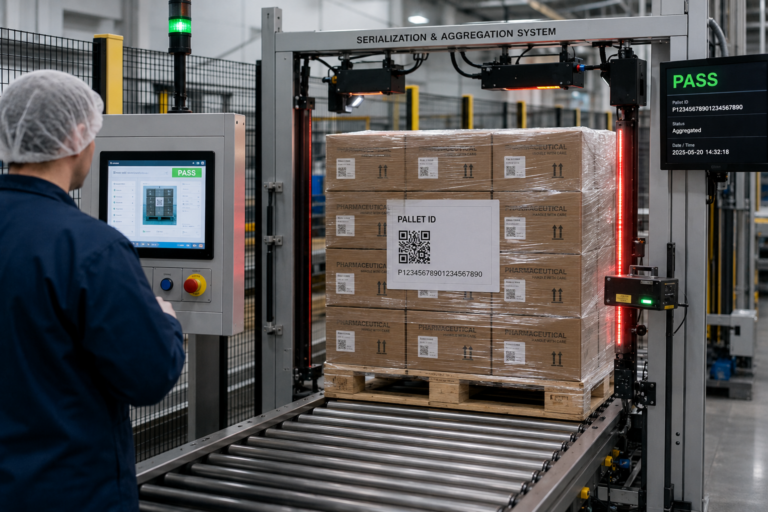
A Qualitas pallet-level aggregation system combines an industrial-grade IPC, operator HMI, and purpose-built aggregation software to manage the complete pallet build workflow — from child pack scan-in through SSCC label generation, EPCIS event creation, and upstream data transmission to the JEKSON serialization repository and ERP.
The aggregation software builds and maintains the parent–child relationship tree for the active pallet. It enforces configurable packaging level rules, tracks expected vs scanned counts, manages pallet open/close/split/rework events, and writes every aggregation action to an immutable audit log with operator ID and timestamp.
| Function | Method | Compliance Standard |
|---|---|---|
| Duplicate serial detection | Real-time hash-set lookup on scan event | GS1 EPCIS / DSCSA |
| GS1 code format validation | Application identifier regex + check digit | GS1 General Spec |
| Hierarchy rules enforcement | Configurable packaging level rules engine | JEKSON / DSCSA Sec. 582 |
| Pallet count validation | Expected vs scanned counter with HMI alert | Operational SOP |
| SSCC label generation | GS1-128 label via integrated label printer | GS1 SSCC standard |
| EPCIS event creation | GS1 EPCIS 2.0 compliant | DSCSA / FMD / GS1 |
| Upstream data transmission | JEKSON API / REST / file-drop / OPC-UA | JEKSON / MES interface |
| Audit trail & e-records | Timestamped, operator-attributed event log | 21 CFR Part 11 |
Expected Outcomes & ROI
Deploying a purpose-built pallet aggregation system addresses compliance gaps immediately while delivering operational efficiencies that accumulate across every pallet, every batch, and every shipment. Most pharma manufacturers achieve measurable ROI within one to two production seasons.
| Outcome | Mechanism | Indicative Impact |
|---|---|---|
| DSCSA / FMD pallet-level compliance | Complete EPCIS event chain from case to pallet | Avoids regulatory penalty and shipment rejection |
| Aggregation error rate | Real-time duplicate + format + count validation | Industry 2–3% → target <0.1% |
| Distribution centre receipt time | Single pallet scan confirms all contents | 50–70% reduction per pallet |
| Rework cost reduction | Errors caught at aggregation workstation, not post-shipment | Eliminates expensive downstream rework |
| JEKSON repository accuracy | Automated push eliminates manual data entry errors | Near-100% hierarchy accuracy |
| 21 CFR Part 11 readiness | Immutable audit trail with operator ID and timestamp | Inspection-ready records on demand |
Implementation Considerations
A phased deployment is recommended: starting with a requirements alignment session to confirm the JEKSON model and interface version, packaging hierarchy levels, and GS1 code structure in use on the target line. A pilot installation on one packaging line — with supervised pallet builds against live batch data — validates the aggregation logic and JEKSON communication before rollout.
Qualitas provides IQ/OQ/PQ validation documentation, FAT/SAT test protocols, and go-live operator training as standard deliverables. The architecture is production-tested, deployable in weeks, and readily extensible to multiple packaging lines, additional hierarchy levels, and new product SKUs.
The full application note covers detailed system architecture, camera and lighting configuration parameters, model training methodology, integration with existing MES and ERP systems, and a step-by-step deployment checklist validated across multiple production sites.