
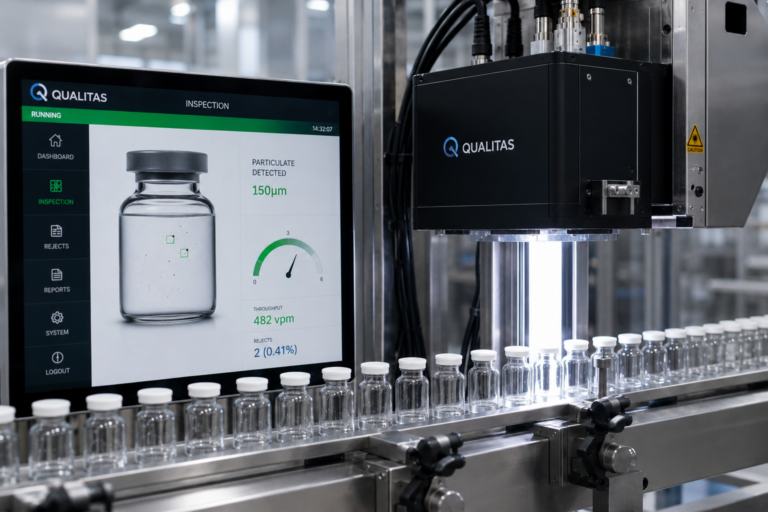
The Inspection Challenge
Visible particulates represent the leading cause of recalls for sterile injectables, accounting for approximately 22% of recall events in FDA reviews. Every glass vial and ampoule must be inspected for visible particulates, container damage, fill anomalies, and closure integrity defects per USP <790>, USP <1790>, EP 2.9.20, and JP 6.06.
At injectable line speeds of 300–600 vials per minute, manual inspection proves infeasible. Trained inspectors manage only 5–10 units per minute with degradation due to fatigue. Automated systems must detect visible particulates of approximately 150 µm and larger at 70% or higher probability of detection while screening for cosmetic, container, and closure defects.
| Quality Dimension | Why It Matters |
|---|---|
| Patient safety | Visible particulates in injectables can cause embolism, phlebitis or immune reactions |
| Regulatory exposure | Particulate findings drive a large share of FDA recalls, warning letters and 483 observations |
| Container integrity | Cracks, chips or seal defects compromise sterility and shelf life of parenteral products |
| Dose accuracy | Fill level deviation outside specification affects dose delivered and labelled volume claim |
| Throughput economics | Manual inspection caps at 5–10 vpm/inspector; modern fill-finish lines run at 300–600+ vpm |
| Brand & supply continuity | A single particulate recall can halt a product line for weeks and impact public health supply |
Why Traditional Inspection Falls Short
| Limitation | Operational Consequence |
|---|---|
| 5–10 vpm per inspector | A 300 vpm line would require 30–60 active inspectors — operationally infeasible |
| Fatigue & attention drift | Defect detection rates fall measurably across a shift, especially on transparent glass |
| Operator-to-operator variability | Re-inspection studies routinely show 15–30% variation between certified inspectors |
| Reflective, transparent glass | Subtle cracks and ≥150 µm particles are easily masked by surface glare and meniscus |
| Subjective grey-zone calls | Borderline cosmetic vs. critical defects classified inconsistently without a digital record |
| No image-level audit trail | Manual decisions cannot be re-verified, frustrating CAPA and root cause analysis |
| Limited Annex 1 alignment | EU GMP Annex 1 (2022) places stronger expectations on contamination control and data |
The Machine Vision Approach
The system operates as three coordinated inspection stations sharing a common controller, defect ontology, and traceability layer. Station 1 (Spin-Detect Particulate Inspection) holds the vial briefly, spins it, and abruptly stops. Inertia keeps any free-moving particulate in motion while fixed cosmetic features remain stationary — 4–8 high-speed cameras at up to 2000 fps detect particles from approximately 150 µm upward.
Station 2 (360° Body, Fill & Stopper Verification) uses six cameras around the conveyed vial to capture full 360° views. Rule-based vision detects cracks, chips, fill level deviation, and stopper position; deep-learning classifiers handle cap dents, crimp anomalies, and ampoule tip-seal flaws. Station 3 (Cap, Crimp and Code Verification) verifies presence, colour, and crimp integrity, while an OCR/OCV pipeline reads batch and expiry codes graded against ISO 15415 print quality criteria.
| Defect Category | Station | Detection Method |
|---|---|---|
| Visible particulates (≥150 µm) | Station 1 | Spin-Detect motion analysis, multi-camera |
| Glass cracks & body chips | Station 2 | Rule-based edge & contour analysis |
| Neck and heel defects | Station 2 | Rule-based with DL fallback for ambiguous cases |
| Fill level deviation | Station 2 | Sub-pixel meniscus localisation |
| Stopper position & integrity | Station 2 | Profile measurement + DL classifier |
| Discoloration & haze | Station 2 | Colour-space and turbidity analysis |
| Ampoule tip-seal defects | Station 2 | DL classifier on top-of-tip imagery |
| Cap, flip-off and crimp | Station 3 | Top-down rule-based with DL classifier |
| Batch code & GS1 DataMatrix | Station 3 | OCR/OCV + ISO 15415 grade |
Expected Outcomes & ROI
| Outcome | Indicative Target |
|---|---|
| 100% inline inspection coverage | Every produced unit inspected for particulates, cosmetic and closure defects |
| Particulate detection sensitivity | Visible particulates from ≥150 µm at ≥70% PoD (USP <1790> alignment) |
| False-reject rate | Typically < 1% on stable SKUs; varies with product complexity and model maturity |
| Line throughput | 300+ vials per minute sustained; configurable to higher speeds |
| Operator deployment | Inspectors reassigned from inline to AQL, CAPA and validation roles |
| Audit trail & data integrity | Unit-level images, decisions and signatures retained per 21 CFR Part 11 |
| CAPA enablement | Image-backed root cause analysis available within minutes of reject |
| Annex 1 / cGMP alignment | Continuous data supports contamination control strategy and PQR |
Implementation Considerations
Deployment follows a phased approach designed to fit around existing fill-finish operations and qualification schedules. A site survey and product/defect characterisation study precede mechanical integration so that camera positions, lighting geometry, and reject actuator timing are sized to the actual container geometry, fill product, and conveyor.
Following installation, the system is challenged with a customer-specific defect library including reference standards from a qualification kit. A documented qualification package accompanies the system and plugs into the customer's validation lifecycle, covering IQ/OQ/PQ protocols and installation/performance qualification.
The full application note covers detailed system architecture, camera and lighting configuration parameters, model training methodology, integration with existing MES and ERP systems, and a step-by-step deployment checklist validated across multiple production sites.