The Safety & Efficiency Gap in Manufacturing
Most large manufacturing facilities already have dense CCTV infrastructure. The problem is that these cameras record passively. A PPE violation happens, it gets captured on footage, and someone discovers it during an end-of-shift review — if at all. Manual surveillance is operationally unscalable: a supervisor covering a large floor cannot simultaneously monitor dozens of camera feeds and respond in real time.
| Problem | Operational Consequence |
|---|---|
| Passive CCTV infrastructure | Cameras record but do not alert. Violations discovered retrospectively, after injury. |
| Manual PPE audits | Spot-check frequency of 1–2 times per shift misses the majority of violations in high-traffic zones. |
| Supervisor bandwidth | A single supervisor cannot monitor 10+ camera feeds simultaneously while managing floor operations. |
| Under-reported incidents | Pressure on suppliers to show zero-accident records suppresses reporting, masking systemic risk. |
| No throughput visibility | Manual count sheets and PLC tallies do not identify which station or shift is constraining output. |
| Reactive safety culture | Without real-time alerts, safety interventions happen after injury — not before. |
Why Conventional Safety Approaches Fall Short
| Conventional Approach | Limitation |
|---|---|
| Manual CCTV review | Retrospective. Cannot prevent an injury that has already occurred. |
| Periodic safety audits | Spot checks create compliance-when-watched behaviour, not sustained safety culture. |
| Barrier-based zone control | Physical barriers are expensive, reduce floor flexibility and are often bypassed. |
| Safety officer walkthroughs | One officer per shift cannot achieve continuous coverage across a multi-zone floor. |
| PLC-based throughput reporting | Reports output from one machine but cannot identify human-side bottlenecks or idle intervals. |
| Cloud-based video analytics | Bandwidth-intensive, introduces latency, and raises data security concerns on production networks. |
The EagleEye AI Video Analytics Approach
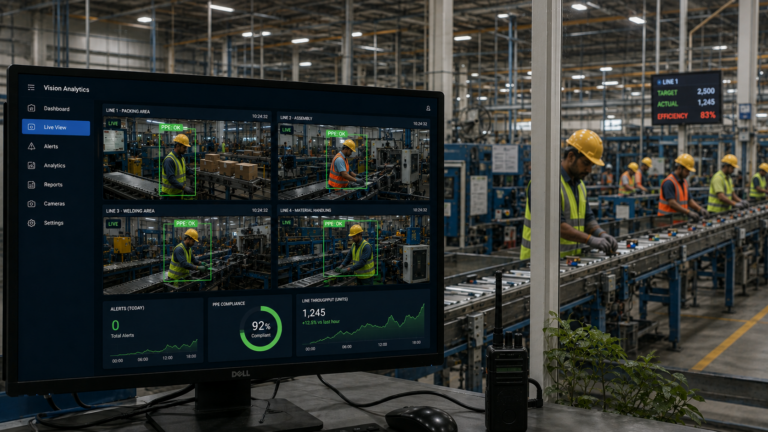
EagleEye is structured around three independent AI inference modules that run simultaneously on an edge appliance connected to the plant's existing ONVIF IP camera network. A real-time object detection model classifies five PPE categories simultaneously: hard hat, safety vest (hi-vis), protective gloves, safety goggles and safety footwear. Each detected person is scored for the required PPE set for that zone — requirements are configurable per camera, per zone and per shift.
Virtual perimeters are drawn directly on the camera view during initial configuration — no physical barriers, cabling or structural modifications required. When a person crosses into a restricted zone, an alert is issued within 500 milliseconds. A counting line drawn across the camera field captures throughput per station, enabling bottleneck analysis and shift-level OEE contribution.
| Detection Capability | Method | Alert Latency |
|---|---|---|
| Hard hat (presence/absence) | Real-time object detection | ≤ 500 ms |
| Safety vest / hi-vis | Object detection + colour classification | ≤ 500 ms |
| Protective gloves | Object detection, hand-region focus | ≤ 500 ms |
| Safety goggles | Face-region object detection | ≤ 500 ms |
| Zone boundary intrusion | Virtual perimeter + person tracking | ≤ 500 ms |
| Time in restricted zone | Time-in-zone tracking | Configurable |
| Line throughput count | Counting-line object crossing | Real-time |
| Shift bottleneck detection | Multi-station count comparison | Per shift |
Expected Outcomes
| Outcome | Indicative Target |
|---|---|
| PPE compliance rate | Sites with enforced automated alerting achieve ≥90% sustained compliance (vs. ≤60% manual audit baseline) |
| Injury reduction | Proper PPE enforcement reduces workplace injuries by up to 60% |
| Alert response time | Supervisor notified within 500 ms of violation; escalation to manager within configurable window |
| Zone intrusion incidents | Measurable reduction in unauthorised machine-area entry within first 30 days of deployment |
| Throughput visibility | Continuous units/hr per station replaces shift-end manual count; bottleneck identified same shift |
| Safety culture shift | From reactive (post-incident review) to proactive (real-time intervention and accountability) |
| Camera infrastructure reuse | Zero additional cameras required for sites with existing ONVIF IP cameras |
| Deployment time | Typical site go-live in under one week; no structural modification required |
Implementation Considerations
EagleEye is a brownfield-first platform — designed to work with the camera infrastructure that already exists on the factory floor, not to replace it. The typical deployment sequence spans less than one week and requires no structural changes, no new cabling beyond LAN connectivity for the edge appliance, and no IT re-architecture.
Initial configuration covers: zone boundary mapping, PPE rule assignment per zone and shift, alert routing, and dashboard and report scheduling. Factory-specific model fine-tuning is performed on-site using footage from the customer's cameras to adapt to lighting conditions, worker clothing and floor layout. All video and AI inference is processed on-site; no footage is transmitted to cloud or third-party servers.
The full application note covers detailed system architecture, camera and lighting configuration parameters, model training methodology, integration with existing MES and ERP systems, and a step-by-step deployment checklist validated across multiple production sites.