Why Bearing Inner Race Inspection Cannot Be Done Manually
The inner race is the innermost steel ring in bearing assemblies, rotating with the shaft and making continuous contact with bearing elements. Surface defects as small as 0.1 mm² pit concentrates rolling-element contact stress by 3–5×, initiating subsurface fatigue cracks leading to spalling within months. IATF 16949:2016 Clause 8.6 mandates conformance verification before release, and major OEM control plans classify bore diameter, out-of-roundness, and surface finish as Special Characteristics requiring 100% inspection.
High-throughput production (100,000 rings/shift at 3-second cycle time) makes continuous manual inspection physically impossible, forcing sampling that creates uninspected gaps. Trained inspectors achieve 80–90% defect detection efficiency on polished metal under controlled lighting; at production speed and shift fatigue, effective efficiency drops to 60–70%, leaving 30–40% of sub-threshold defects uninspected.
Why Traditional Methods Fail to Inspect the Inner Race
| Method | Limitation | Operational Impact |
|---|---|---|
| Manual Visual Inspection | Human defect detection efficiency 60–90% on polished metal; throughput ceiling ~1,200 rings/hour per operator | Systematic escape of sub-threshold scratches and pits; fatigue-driven variance across shifts |
| Profilometer (CMM Sampling) | Contact measurement; 3–8 minutes per ring; max sample rate ~5% | Process drift undetected between samples; no per-ring traceability |
| Air Gauging (Bore Diameter) | Single-point bore measurement only; no surface inspection; no out-of-roundness | Passes oval bores where diameter at gauging axis is in tolerance |
| Generic Machine Vision (Diffuse) | Diffuse illumination on polished steel produces specular wash-out; raceway scratches undetectable | False pass rates > 15% for scratches < 0.3 mm width |
| End-of-Line Vibration Test | Detects assembled bearing noise — not individual ring defects | Defective rings pass through full assembly before detection; rework cost 5–8× higher |
| Sampling-Based SPC | Statistical method cannot account for tool wear spikes or contamination events | Individual defective rings between samples are passed; not accepted by most OEMs |
Dual-Pass Inline Inspection — Post Super-Finishing
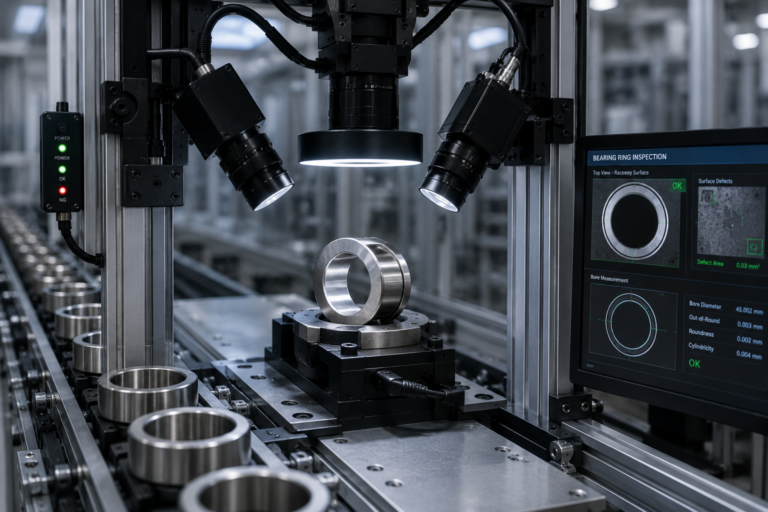
The system deploys a single inspection station immediately after super-finishing/honing. The station operates in two measurement passes during a single 360° rotation on a V-block air spindle fixture. Pass 1 scans the raceway surface under dark-field annular LED illumination to detect and classify surface defects. Pass 2 captures bore profile under coaxial telecentric optics to measure diameter, out-of-roundness, and raceway width. Total cycle time is ≤ 4 seconds per ring.
| Inspection Parameter | Technical Approach | Performance |
|---|---|---|
| Raceway scratch | Dark-field annular LED + YOLOv8 line detection on unwrapped raceway image | > 97% detection for scratches ≥ 0.05 mm width; < 1.5% false reject |
| Pitting / indentation | Coaxial pass + pit area threshold on unwrapped raceway image | > 95% detection for pits ≥ 0.05 mm² |
| Burr / edge flash | Dark-field edge profile analysis; height above nominal threshold at bore chamfer | > 96% detection for burrs ≥ 0.03 mm height |
| Micro-crack / heat crack | Dark-field + fracture line segmentation on raceway; crack width ≥ 0.02 mm | > 94% detection |
| Helical grinding mark | Texture frequency analysis on unwrapped raceway image | > 93% detection at Ra deviation ≥ 0.05 µm above set-point |
| Bore diameter | Telecentric sub-pixel edge detection; least-squares circle fit at 8+ positions | ±1 µm repeatability (2σ); range 15–120 mm bore diameter |
| Out-of-roundness | Max–min radial deviation of bore across full 360° rotation | Resolution 0.5 µm; tolerance limits configurable per part recipe |
| Cycle time | Dual-pass on single 360° rotation; encoder-triggered capture | ≤ 4 s per ring; compatible with 50,000–150,000 inner races/shift |
Expected Outcomes & Return on Investment
| Outcome Metric | Baseline (Manual / Sampling) | With Qualitas Inline System |
|---|---|---|
| Inspection Coverage | 5–10% sampling (manual constraint) | 100% — every inner race inspected, every shift |
| Raceway Defect Detection Efficiency | 60–70% at production speed and fatigue | > 95% across all defect types |
| Bore Diameter Measurement | Periodic air gauging; 2–4 measurements per shift | Every ring; ±1 µm; SPC Cpk auto-calculated per batch |
| Per-Ring Traceability | Batch-level pass/fail log only | Per-ring raceway image + bore measurement record; PPAP-ready export |
| Defect Escape to OEM | Estimated 2–5% of defective inner races reach dispatch | < 0.1% with dual-pass inline detection |
| IATF 16949 Audit Readiness | Sampling records; no image evidence | Per-ring raceway image archive; Cpk / Ppk from 100% data |
| Warranty Charge-Back Exposure | ₹1–3 crore/year per high-volume inner race line | Near-zero — defective rings rejected before dispatch |
| System Payback Period | — | Typically 10–18 months on a 50,000+ inner races/shift line |
Implementation Considerations
The station footprint is 600 × 800 mm — compatible with standard post-honing conveyor layouts without line modification. IP54-rated enclosures with positive-pressure air purge protect optics in coolant-mist environments. A minimum training dataset of 800–1,500 annotated raceway images per defect class is required for the surface detection model.