The Three Problems After the Oven
India's biscuit sector, valued at USD 5.05 billion in 2024 with 9.6% yearly growth, relies on mid-size regional bakeries producing 50–200 MT monthly. Multi-lane post-oven conveyors moving product from cooling belts through comb dividers into 2–3 packaging lanes present three unmeasured quality and productivity challenges: existing lane sensors count throughput without assessing biscuit condition; post-oven shingling causes photoelectric sensors to under-count by 5–20%; and worn or misaligned comb dividers result in one lane running 20–40% lighter than others for entire shifts undetected.
| Method | Limitation | Operational Impact |
|---|---|---|
| Photoelectric Beam Sensor (per lane) | Counts axis-crossings only; touching biscuits register as one event | 5–20% under-count during shingling; no defect data; one sensor per lane required |
| Weight-Based Batch Check | Weighs total batch after packing — not per-lane, not inline | Detects total weight variance only; cannot locate which lane, which biscuit, or which oven zone |
| Manual Visual Spot-Check | Operator samples 5–10 biscuits per hundred; fatigue degrades performance | Broken rate detection < 40% at production speed; no lane-balance monitoring possible |
| End-of-Line Checkweigher | Per-pack weight check; cannot inspect individual biscuit condition | Broken pieces within weight tolerance pass; short-packs at edge of tolerance also pass |
| Single-Lane Vision System | One camera per lane; independent systems cannot perform cross-lane balance analysis | Linear hardware cost; no unified per-lane comparison |
AI Video Analytics — One Camera, Three Outputs
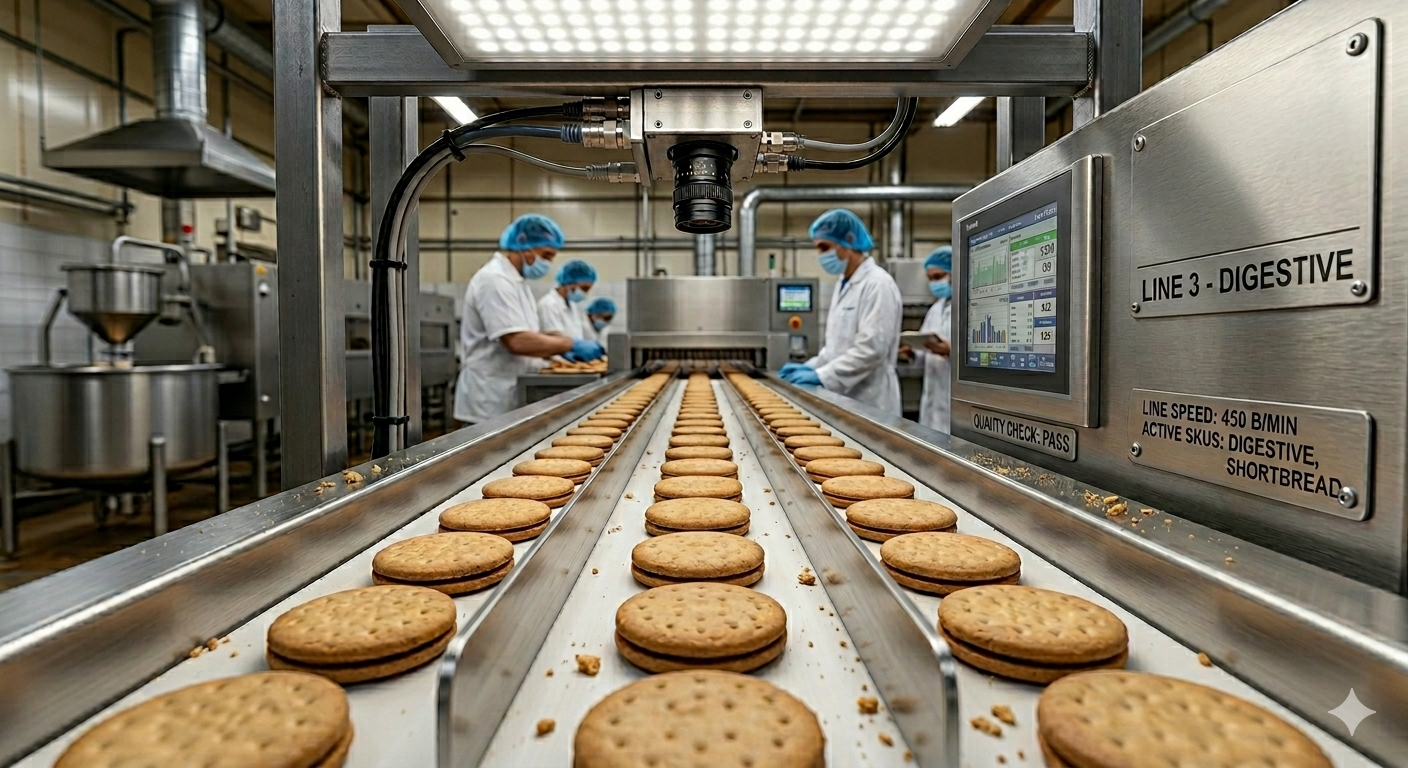
Qualitas Technologies mounts a single 5 MP GigE camera with wide-field-of-view lens above the post-oven multi-lane conveyor at 500–650 mm height, covering 2–3 lanes of 28–38 mm diameter round biscuits simultaneously at 5–8 pixels/mm resolution. A full-width diffuse LED bar eliminates shadows and specular hot-spots from glazed biscuit surfaces.
A YOLOv8-seg instance segmentation model processes each frame and outputs per-instance masks. Individual biscuits separate even when touching or partially overlapping, using watershed post-processing on dense clusters. Three simultaneous outputs are produced per frame: a per-lane count event when biscuit centroid crosses its virtual count line; a defect classification (WHOLE, BROKEN, DEFORMED, COLOUR_ANOMALY); and a per-lane running count ratio used to compute the lane-balance metric.
| Detection Scenario | Technical Approach | Performance |
|---|---|---|
| Multi-lane count (2–3 lanes) | Single wide-FOV camera; per-lane virtual count lines with centroid assignment | > 99% count accuracy on well-separated flow; > 96% during shingling |
| Touching / shingled biscuits | Instance segmentation + watershed; individual masks even at 70% overlap | > 96% separation accuracy on 28–38 mm round biscuits at up to 25 FPS |
| Broken biscuit detection | Area ratio < 0.6 of median whole-biscuit area flags as broken fragment | > 95% detection; < 2% false reject on normally-shaped whole biscuits |
| Deformed / misshapen biscuit | Circularity score < 0.75 or aspect ratio > 1.4 flags as deformed | > 93% detection on deformation ≥ 15% of expected diameter |
| Over-baked colour anomaly | Per-instance colour histogram vs. shift baseline; Δ hue > threshold triggers alert | > 94% detection at oven zone temperature deviations of ≥ 8°C above set-point |
| Lane imbalance / comb fault | Per-lane count ratio vs. mean; ±20% deviation for 60 s triggers alarm | Alert fires within 30 s of sustained imbalance; tested on 3-lane lines |
Expected Outcomes & Return on Investment
| Outcome Metric | Baseline (Sensor + Manual) | With Qualitas AI System |
|---|---|---|
| Count Accuracy | 92–95% (beam sensor, shingling conditions) | > 99% with instance segmentation |
| Broken Biscuit Catch Rate | < 40% at manual spot-check rate | > 95% inline, every biscuit inspected |
| Lane Imbalance Detection | End-of-shift yield reconciliation | Alert within 30 s of sustained imbalance |
| Hardware per 3-Lane Line | 3 sensors + 3 mounts + 3 PLC inputs | 1 camera + 1 IPC + 1 LED bar |
| Colour Anomaly Detection | Manual sample; reactive | Inline, from first biscuit of affected batch |
| Broken-Rate Trend Data | None; no systematic record | Per-shift trend logged; correlatable to oven zone data |
| System Payback Period | — | Typically 10–18 months for a 100–200 MT/month line |
Implementation Considerations
Phase 1 (3–5 weeks): the system deploys on the highest-volume lane configuration with counting and broken-biscuit detection active. A baseline broken rate establishes per shift. Phase 2 (3–5 weeks): colour-anomaly detection activates and correlates with oven zone temperature logs; ERP/MES integration commissions for batch-level count and yield push. Phase 3 extends the solution to additional lines.
The single-camera hardware footprint — one 5 MP GigE camera, one IP65 LED bar, one NVIDIA Jetson AGX Orin IPC — mounts above the existing conveyor with no modification to the belt, comb, or line structure. Total overhead clearance required is 120 × 120 mm for the camera housing. Stainless steel IP54 enclosures are standard for food-grade environments.
The full application note covers detailed system architecture, camera and lighting configuration parameters, model training methodology, integration with existing MES and ERP systems, and a step-by-step deployment checklist validated across multiple production sites.