The Quality Gap Before the Carton Closes
India's packaged drinking water sector, valued at approximately ₹38,000 crore in 2024 with annual growth of 13–15%, relies on regional bottlers operating at 60–200 bottles per minute. The accumulation conveyor between capper and packing station represents the final inspection opportunity before sealed cartons reach retail. The capper's torque sensor confirms tightening force but cannot detect a skewed thread, a wrong-colour cap from a batch changeover, or a hairline crack.
| Method | Limitation | Impact at Packing Gate |
|---|---|---|
| Torque / Capper Sensor | Confirms capping force only — no visual check for angle, colour, or post-cap damage | Skewed and wrong-colour caps pass undetected |
| Photoelectric Beam Sensor | Binary presence/absence only; no classification | Counts bottles but cannot flag any cap defect type |
| Manual Spot-Check | Operator samples 3–5 bottles per 100 at reduced attention; fatigue degrades to <70% catch rate | Systematic defects persist into carton packing |
| Weight-Based Carton Check | Tolerances set for fill variation; a single missing cap (≈2 g) is within noise floor of most checkweighers | Missing-cap bottles pass as correctly packed |
| End-of-Line Sampling | Post-pack inspection cannot open sealed cartons economically | Rework cost is 4–6× higher than inline rejection |
AI Video Analytics Approach
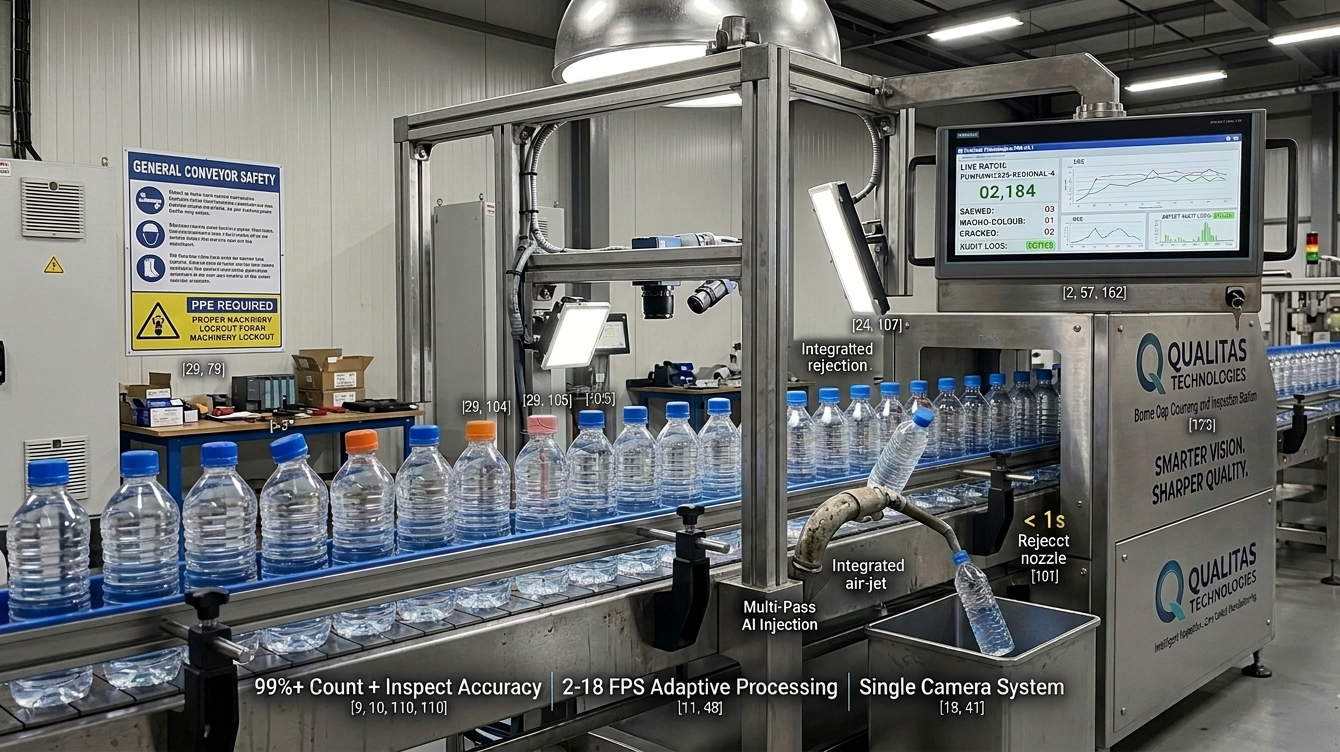
Qualitas Technologies deploys an overhead industrial camera with diffuse dome LED illuminator above the accumulation conveyor, feeding a YOLOv8-based inference pipeline on edge IPC. The system performs count and defect detection in a single forward pass per frame. At 60–120 bottles/min the system operates at 8–12 FPS; at 121–200 bottles/min it escalates to 15–18 FPS via motion pre-filter.
A custom YOLOv8 model outputs per-frame detections with class labels: GOOD_CAP, MISSING, SKEWED, CRACK, WRONG_COLOUR. Virtual count line triggers confirmed count event as each bottle crosses it; associated class label logged simultaneously. Defect events trigger sub-100 ms air-jet or divert-gate reject signal via PLC interface, removing flagged bottles before carton loading.
| Detection Scenario | Technical Approach | Performance |
|---|---|---|
| Missing cap | Absence detection — no cap-class bbox in bottle ROI | > 99.5% detection rate; near-zero false reject |
| Skewed / tilted cap | Bounding-box aspect ratio + angle estimation from cap contour | > 97% at skew angles ≥ 3° at 200 bottles/min |
| Wrong-colour cap | Colour histogram + per-class DL classifier in single pass | > 98% on 8 concurrent cap colour classes |
| Cracked / damaged cap | Edge detection + crack segmentation on cap surface region | > 95% for cracks ≥ 0.3 mm width under dome lighting |
| Count mismatch | Virtual count line + ByteTrack ID persistence per bottle | > 99% count accuracy at 60–200 bottles/min |
| Batch changeover error | WRONG_COLOUR class triggers colour mismatch alarm with batch ID | Alerts within 1 bottle of first wrong-colour cap |
| Reject signal | Sub-100 ms PLC output; air-jet or divert gate compatible | Tested on Siemens S7 and Allen-Bradley ControlLogix |
Expected Outcomes & Return on Investment
| Outcome Metric | Baseline (Current Line) | With Qualitas AI System |
|---|---|---|
| Cap Defect Escape Rate | 0.3–0.8% of production at 200 bpm | < 0.05% — near-zero carton entry |
| Count Accuracy | 96–98% (beam sensor) | > 99% with per-bottle image record |
| Wrong-Colour Cap Catch Rate | < 70% at manual spot-check rate | > 98% — alarm within 1 bottle |
| FSSAI Audit Readiness | Manual paper logs; no image evidence | Timestamped JPEG archive per shift, exportable |
| Retail Return Rate (Cap) | Varies; 0.1–0.3% of shipped cartons | Target < 0.01% with inline quality gate |
| Capper Wear Detection | Reactive — noticed after complaints | Proactive — skew rate trend flags capper maintenance |
| Payback Period | — | Typically 10–16 months on a 100k-bottle/shift line |
Implementation Considerations
The adaptive FPS architecture keeps hardware to an entry-level NVIDIA Jetson AGX Orin IPC, a single 5 MP GigE camera, and a dome LED panel — a total hardware footprint that typically occupies 400 × 400 mm of conveyor headspace with no line modification required. Stainless steel IP65-rated enclosures are standard for food and beverage environments.
Detection model training uses 1,000–3,000 annotated frames per cap colour class captured under production dome lighting. Recipe system stores per-SKU cap colour profiles; at SKU changeover, operator selects new recipe on HMI and system switches colour-class thresholds in under 30 seconds, with automatic validation on first 20 bottles of new run.
The full application note covers detailed system architecture, camera and lighting configuration parameters, model training methodology, integration with existing MES and ERP systems, and a step-by-step deployment checklist validated across multiple production sites.