The Fabrication Workshop Challenge
Workshops performing welding and thermal cutting face dual pressures: workers encounter arc flash, hot metal, grinding sparks and toxic fumes where PPE compliance is critical; simultaneously, undetected welding and cutting defects become costly rework or field failures. Traditional supervision relies on periodic floor walkarounds, post-incident CCTV review, and end-of-process inspection — none delivering the continuous real-time visibility needed for prevention.
| Challenge Area | Current Limitation | Business Impact |
|---|---|---|
| PPE compliance monitoring | Periodic supervisor walkarounds miss violations between rounds | Regulatory exposure, accident risk |
| Restricted zone enforcement | No automated detection of zone intrusion near active hazards | Burn/crush injury potential |
| Production visibility | No real-time data on station utilisation or WIP flow | Bottleneck blindness, low OEE |
| Weld defect detection | Visual inspection post-weld; defects found after joint is cold | Rework cost, scrap generation |
| Cut quality assessment | Manual gauge checks; irregular coverage by operator | Tolerance escapes, downstream fit-up issues |
Why Conventional Systems Fall Short
Standard CCTV remains passive; it records but does not analyse. AI transforms identical camera infrastructure into an active intelligence layer without physical modification. Time lag — the interval between occurrence and detection — undermines conventional approaches. AI vision collapses this lag to seconds for safety events and to the moment of weld completion for quality events.
| Approach | Limitation | Gap It Leaves |
|---|---|---|
| Standard CCTV monitoring | Passive recording only; humans review footage after events | No real-time alerts, no analytics |
| Manual PPE audits | Spot-checks 2–3 times per shift; coverage is incomplete | Violations undetected between rounds |
| End-of-process weld inspection | NDT or visual after cooling; cannot correct in-process | Defects locked in before detection |
| Manual production tracking | Paper or operator-entered data; delayed and inaccurate | OEE figures unreliable, RCA slow |
| Periodic quality gauging | Sampled coverage only; relies on operator diligence | Systematic defects escape to despatch |
Suggested AI Vision Platform Architecture
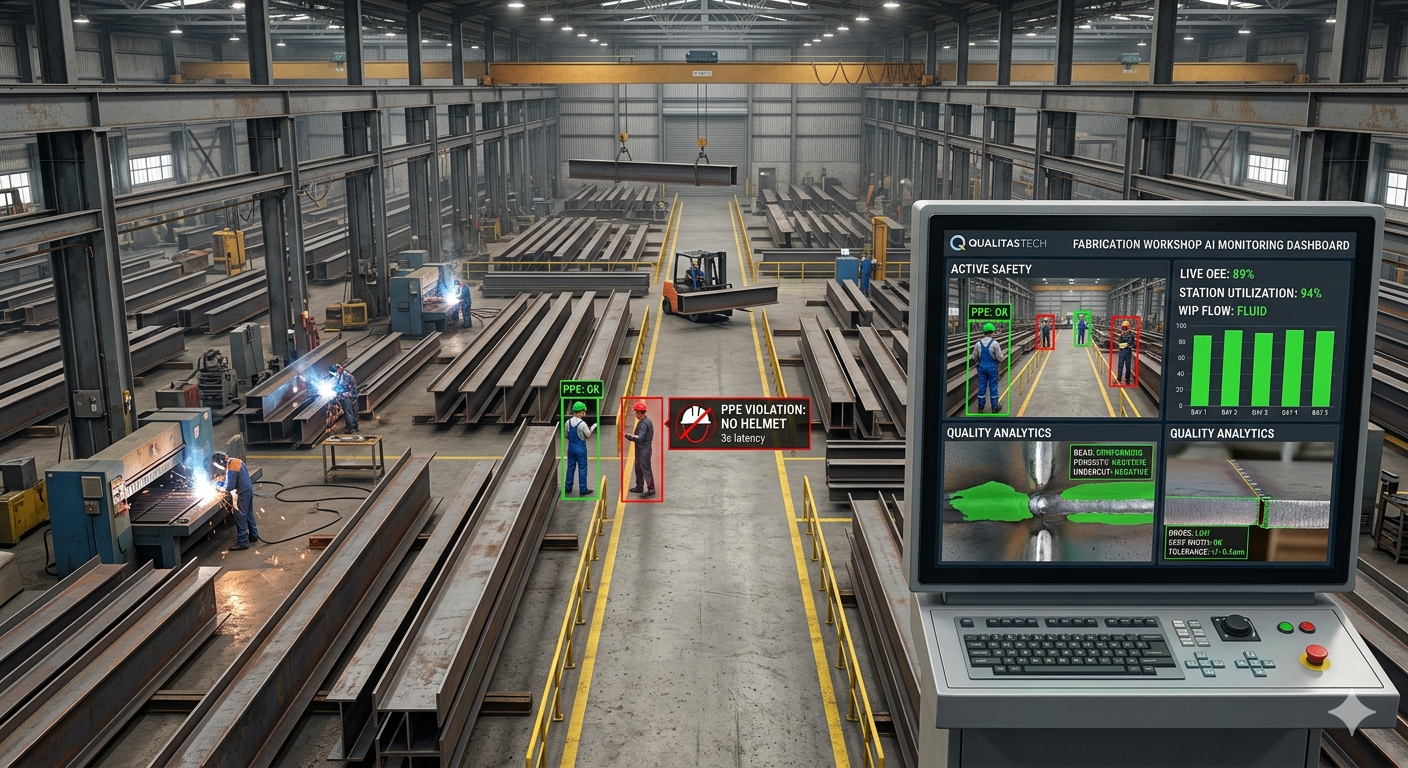
The platform deploys strategically positioned industrial cameras connected to a shared edge AI inference server running four concurrent model streams: PPE and safety monitoring, production tracking, weld quality analytics, and cut quality analytics. PPE detection classifies helmet, safety glasses, gloves, hi-vis vest, and safety shoes — triggering alerts within three seconds for missing items. Weld station cameras capture bead geometry, surface morphology, and spatter during and immediately after welding; deep learning segmentation classifies porosity, undercut, incomplete fusion, and crater defects.
| Detection Capability | AI Method | Alert / Output | Latency |
|---|---|---|---|
| Helmet / hard hat absence | Object detection + keypoint | Dashboard + SMS/siren | < 3 sec |
| Safety glasses / gloves missing | Multi-class PPE detection | Dashboard alert | < 3 sec |
| Restricted zone intrusion | Person detection + ROI polygon | Dashboard + siren | < 2 sec |
| Station utilisation (active/idle) | Activity recognition | Production MIS update | Per minute |
| Weld bead porosity / spatter | Segmentation DL model | Quality event log | Post-weld |
| Weld undercut / crater defect | Edge + anomaly detection | Rework flag | Post-weld |
| Cut dross / slag accumulation | Texture + morphology DL | Quality alert | Post-cut |
Expected Outcomes & ROI
A single lost-time injury in fabrication carries average costs exceeding ₹10–50 lakhs including medical expenses, legal liability, regulatory penalties, productivity loss, and reputational harm. AI safety monitoring recoups its full deployment cost by preventing one serious incident. Rework typically represents 5–15% of project cost in heavy fabrication; early defect detection substantially reduces this figure.
| Outcome Metric | Baseline (Manual / CCTV) | Target (AI Vision) | Improvement |
|---|---|---|---|
| PPE compliance rate | 70–85% (spot-check observed) | > 95% (continuous) | > 15 ppt improvement |
| Time to detect safety violation | Minutes to hours (post-event) | < 3 seconds (real-time) | Near-zero lag |
| Weld rework rate | 5–12% of joints reworked | < 3% (early detection) | > 50% rework reduction |
| Cut quality escapes | Sampled gauging, not 100% | 100% camera coverage | Zero escapes to next station |
| Incident investigation time | Days of footage review | Tagged clip available < 1 min | > 90% faster RCA |
Implementation Considerations
A three-phase rollout prioritises PPE and safety monitoring first, commencing with camera placement assessment across all bays and entry points. Phase 1 becomes operational within 6–8 weeks. Phase 2 activates production tracking analytics and integrates dashboards with existing MES or ERP systems. Phase 3 deploys close-range weld and cut quality cameras with AI model training on client-specific joint types and tolerances.
Most sites complete all three phases within 16–20 weeks of project initiation, with Phase 1 alerts generating immediate value during subsequent phases. Phasing by use case allows teams to validate each capability independently and build operator familiarity before scope expansion.
The full application note covers detailed system architecture, camera and lighting configuration parameters, model training methodology, integration with existing MES and ERP systems, and a step-by-step deployment checklist validated across multiple production sites.