The Label Print Inspection Challenge
The global printing inspection market valued at USD 2.04 billion in 2024 grows at 9.1% CAGR. Modern press speeds of 60–150 metres per minute exceed manual inspection capacity. A single defective label release causes retailer chargebacks, costly product recalls, and lasting reputational damage.
| Risk Factor | Business Impact | Frequency/Magnitude |
|---|---|---|
| Mislabelled pharmaceutical product | Regulatory recall + licence risk | FDA/CDSCO: up to 100% lot recall |
| Unreadable barcode | Retailer chargeback / line rejection | ₹50,000–₹5,00,000 per incident |
| Brand colour deviation (ΔE > 4) | Brand equity damage + rework | Brand guideline breach |
| Wrong expiry / batch text | Consumer safety hazard | Mandatory product withdrawal |
| Cosmetic defects (smear, pinhole) | Shelf appearance failure | 15–30% rework rate (manual lines) |
| Missing serialisation code | Track-and-trace compliance failure | GS1 / FSSAI / Drug Controller penalty |
Why Traditional Inspection Falls Short
Human visual inspectors working at high-speed label lines can reliably detect fewer than 70% of print defects under production conditions. Inspector fatigue, variable lighting, and subjective color perception cause significant pass-through rates.
| Limitation | Root Cause | Consequence |
|---|---|---|
| Human fatigue & attention decay | Cognitive overload at 80–150 m/min | Missed defects increase after 30 min |
| Colour subjectivity | No measurable ΔE standard enforced | Brand guidelines routinely violated |
| Sampling-based inspection | Impractical to check every label | Defective labels escape to market |
| OCR verification impractical | No tool to read every printed character | Wrong dates / batches go undetected |
| Barcode grading not inline | Post-print lab check only | Entire roll rejected after production |
| No traceability data | Paper-based QC logs | Impossible to audit specific defect trends |
Suggested Machine Vision Architecture
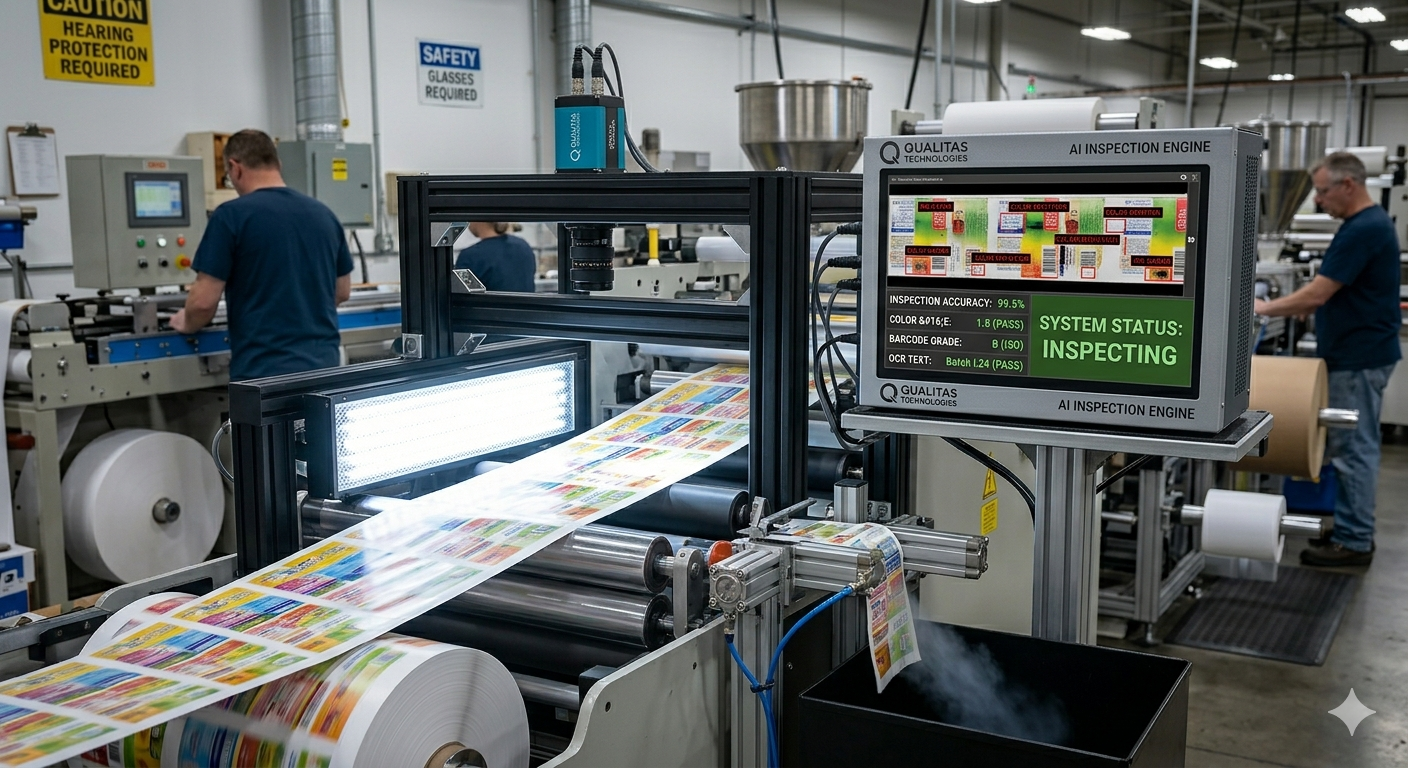
Station 01 (Image Capture): A 4K colour line-scan camera, encoder-triggered to press speed, captures the full label surface at up to 500 dpi resolution. Diffuse LED strobe illumination maintains color accuracy across CMYK, spot-colour, and UV-varnished labels with zero edge-to-edge blind spots.
Station 02 (AI Inspection Engine): Combines rule-based algorithms and deep learning on industrial IPC. OCR reads character fields; OCV verifies against templates or live databases. Delta-E CIE2000 color measurement flags deviation (ΔE < 2 pharma; ΔE < 4 FMCG). Barcode/QR grading per ISO/IEC standards. Each label receives a PASS/FAIL verdict within 5 ms of capture.
| Defect Type | Detection Method | Sensitivity | Applicable Standard |
|---|---|---|---|
| Ink smear / smudge | Blob analysis + edge detection | Sub-0.3 mm² | ISO 12647 |
| Missing / faded print | OCR + contrast check | < 5% density drop | ISO 12647 |
| Barcode / QR readability | ISO decode + grade | Grade D threshold | ISO/IEC 15416 / 15415 |
| Colour deviation (ΔE) | CIE2000 colorimetric | ΔE ≥ 1.5 flagged | ISO 12647-2 |
| Wrong / transposed text | OCV string comparison | Single-char error | GMP / FSSAI |
| Label misalignment / skew | Pattern match + angular offset | ± 0.5 mm | ISO 11798 |
| Pinholes / voids | Threshold + morphology | Sub-0.2 mm | ISO 12647 |
| Missing serialisation code | Presence detection + OCV | N/A | GS1 / UDI |
Expected Outcomes & Return on Investment
| Outcome Metric | Baseline (Manual) | With Machine Vision | Improvement |
|---|---|---|---|
| Defect detection rate | 55–70% | > 99.5% | +30–45 pp |
| False reject rate | N/A (sampling) | < 0.3% | New capability |
| Rework / waste rate | 8–20% | < 2% | 75–90% reduction |
| Barcode first-pass scan rate | 92–95% | > 99.8% | +4–8 pp |
| Inspection throughput | 10–30% of labels | 100% coverage | Full coverage |
| Defect traceability | Paper logs / nil | Digital, real-time | Full audit trail |
| Labour cost (QC) | Dedicated QC team | Supervisory only | 60–80% saving |
| Payback period | — | 12–24 months typical | Positive ROI |
Implementation Considerations
A minimum of 20–50 approved "golden" label samples per SKU is recommended for template creation and color profiling. Deep learning requires 50–200 defect-positive images per class for robust training. Each new label SKU requires a short template-creation step, typically completed in under 30 minutes.
Phase 1 covers feasibility and camera positioning validation on a single press. Phase 2 adds encoder coupling, PLC handshake, reject mechanism, and ERP/MES integration. Phase 3 deploys to additional lines leveraging centralised dashboard and shared model base.
The full application note covers detailed system architecture, camera and lighting configuration parameters, model training methodology, integration with existing MES and ERP systems, and a step-by-step deployment checklist validated across multiple production sites.