The Four Assembly Conditions That Cannot Be Verified Simultaneously by Hand
At an Indian OEM engine plant processing 40–100 engines hourly, four independent conditions must be correct on every piston: circlip seating in gudgeon pin bore grooves on both sides; all three piston rings present with gaps staggered at 120° intervals; gudgeon pin fully inserted with no proud ends; piston crown directional arrow facing correct direction relative to connecting rod.
Missing circlips cause gudgeon pin migration, cylinder bore scoring, and engine seizure within hours. Missing or incorrectly positioned rings cause compression loss and oil consumption. All four failure modes generate warranty claims that cost Indian OEMs ₹15,000–₹80,000 per engine event. At 60 engines per hour, operators have 60 seconds per engine across all operations, making simultaneous verification of all four conditions impossible.
Why Traditional Verification Methods Leave This Gap Open
| Method | Limitation | Impact at Assembly Station |
|---|---|---|
| Manual Torch Inspection | Operator physically looks into bore with torch; 60 s/engine budget makes this impractical at speed | < 60% detection efficiency on circlip seating; ring gap angle not measured — estimated by eye |
| Mechanical Poka-Yoke Fixture | Can prevent wrong-sized ring or pin; cannot verify circlip seating depth or ring gap angular position | Prevents gross errors; misses partial seating, near-miss gap alignment, and orientation reversals |
| Single Overhead Camera | Sees crown and ring gaps from above; cannot see circlip groove inside bore or pin end depth | Partial verification only; circlip — the most critical failure mode — remains uninspected |
| Torque / Force Sensor on Assembly Tool | Confirms circlip insertion force was applied; cannot distinguish between correctly seated and resting-on-groove | False confidence — operator receives "green" signal even when circlip is not fully snapped into groove |
| End-of-Line Compression Test | Tests assembled engine; detects compression loss from ring errors; cannot isolate piston or defect type | Rework at engine level costs 4–6× more than pre-assembly rejection |
4-Camera Inline Assembly Verification — One Station, Four Conditions
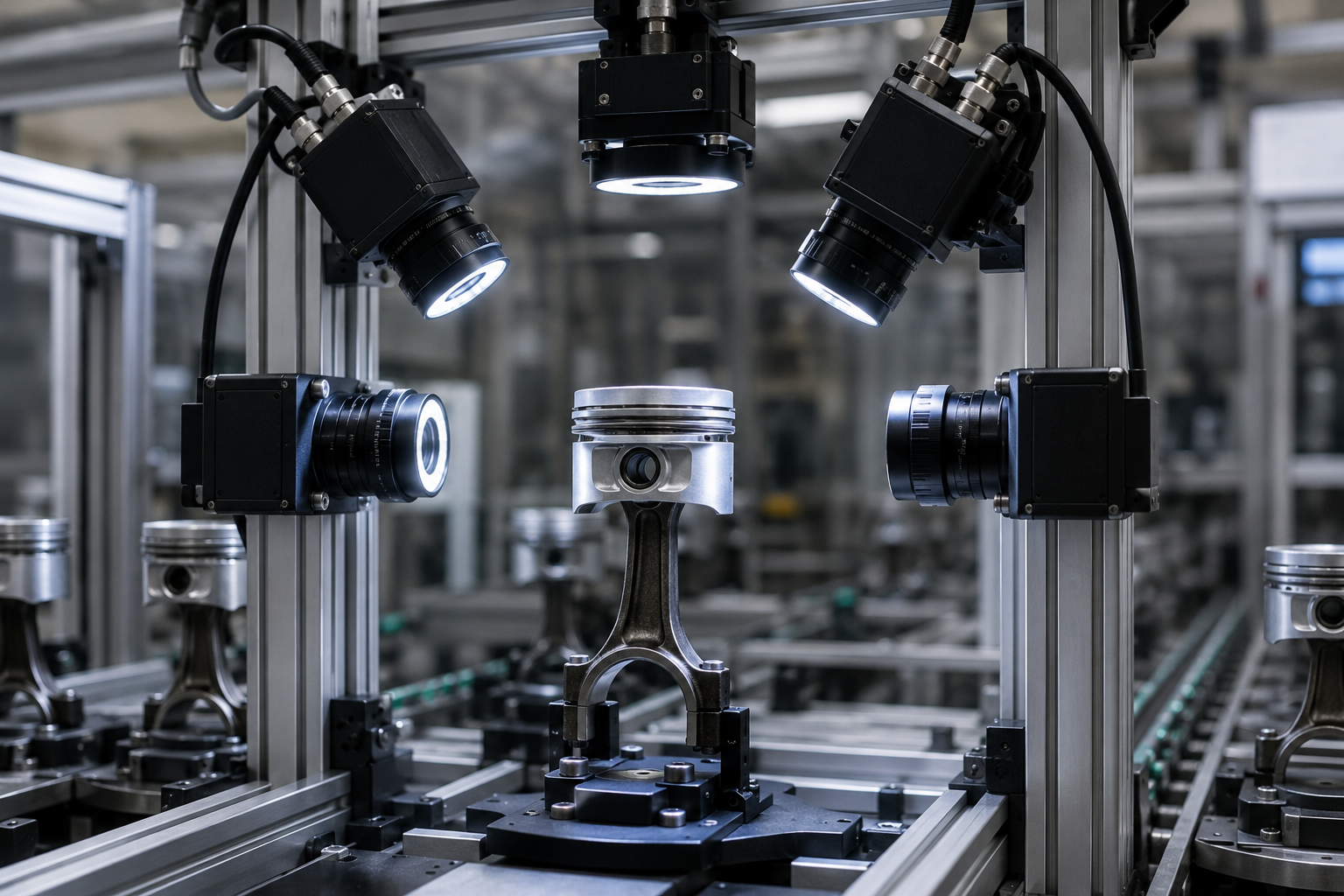
Qualitas Technologies deploys four cameras at a single indexed station embedded in the piston and connecting rod assembly conveyor. When each piston assembly arrives at the station, the conveyor pauses for a programmable index stop of 450–600 ms. Camera 1 (Overhead) verifies ring count, ring gap stagger angles, and crown directional arrow. Cameras 2 & 3 (Left & Right Side) measure gudgeon pin seating depth on both ends. Camera 4 (Angled Bore-Entry Probe) images the circlip groove inside the piston boss bore.
| Assembly Condition | Camera & Technical Approach | Performance |
|---|---|---|
| Circlip present and seated (left bore) | Cam 4 bore-probe · Seeger ring profile segmentation in groove | > 99% detection; distinguishes seated vs resting-on-groove |
| Circlip present and seated (right bore) | Cam 4 bore-probe · mirror-beamsplitter dual-groove capture | > 99% detection; both grooves in one 150 ms capture |
| Piston ring 1 — present and correctly oriented | Cam 1 overhead · ring groove occupancy + TOP marking classify | > 97% detection; TOP marking verified vs variant recipe |
| Piston ring 2 — present and gap position | Cam 1 overhead · radial line detection; gap angle ±15° tolerance | > 97% gap position at 120° stagger from ring 1 |
| Piston ring 3 — present and gap position | Cam 1 overhead · radial line detection; gap angle ±15° tolerance | > 97% gap position at 120° stagger from ring 2 |
| Gudgeon pin depth — left side | Cam 2 side-left · sub-pixel edge detection; proud-end ≤ 0.1 mm | ±0.05 mm repeatability; flags proud and recessed |
| Gudgeon pin depth — right side | Cam 3 side-right · bilateral symmetry check | Symmetric seating confirmed; single-side insertion detected |
| Piston crown orientation | Cam 1 overhead · DL arrow direction classifier; multi-variant model | > 99% classification across 6 piston variants |
Expected Outcomes & Return on Investment
| Outcome Metric | Baseline (Manual / Poka-Yoke) | With Qualitas 4-Camera System |
|---|---|---|
| Assembly Error Detection Coverage | < 60% manual efficiency; poka-yoke covers gross errors only | 100% — all 4 conditions verified on every piston, every shift |
| Circlip Escape Rate | Estimated 0.1–0.3% of pistons (partial seating undetected) | Near-zero — bore-probe detects seated vs resting-on-groove |
| Ring Gap Verification | Visual estimate by operator — not measured | Radial gap angle measured ±15°; every ring on every piston |
| Gudgeon Pin Depth | Not currently measured inline | Both ends measured ±0.05 mm; symmetric seating confirmed |
| Piston Orientation Error | Detected only if operator notices — < 70% catch rate at speed | > 99% — crown arrow classified across all variants |
| Engine Rework at End-of-Line | 4–8 engines/shift requiring partial disassembly | Target zero — errors caught and corrected at sub-assembly |
| Warranty Claim Exposure (Circlip) | ₹50,000–₹80,000 per event | Near-zero — no defective piston enters engine build |
| System Payback Period | — | Typically 8–14 months at 60 engines/hour, 2-shift operation |
Implementation Considerations
The 4-camera gantry frame mounts above and to the sides of the conveyor within a 700 × 900 mm footprint. IP54-rated enclosures protect all camera housings and the edge IPC in the oil-mist environment of an engine assembly shop. A positive-pressure air purge system prevents bore swarf contamination.
The system stores inspection recipe per piston variant (ring count, ring gap tolerance, pin diameter, crown arrow reference, match-mark OCR font). At variant changeover, the operator scans a barcode on the piston tray and the system loads the correct recipe in under 5 seconds. The discrete I/O hard-wired to conveyor PLC inhibits conveyor advance until a PASS is received — no software-only interlock.
The full application note covers detailed system architecture, camera and lighting configuration parameters, model training methodology, integration with existing MES and ERP systems, and a step-by-step deployment checklist validated across multiple production sites.