
The Wood Plank Inspection Challenge
The global wood-based panel market was valued at USD 198 billion in 2024 and is projected to reach USD 284 billion by 2030 at a CAGR of 5.9%, driven by surging construction and furniture demand. For wood plank manufacturers, the challenge is threefold: ensuring every plank meets dimensional tolerances; detecting and classifying surface and structural defects including knots, cracks, holes, and damaged areas; and doing all of this inline at production speed without slowing the line.
Research confirms that manual inspection rarely achieves 70% defect detection reliability due to eye fatigue and perceptual limits, while automated machine vision systems consistently achieve 95–98% accuracy — a gap that directly translates to rejects, returns, and wasted material.
| Inspection Requirement | Manual Approach Limitation | Business Impact |
|---|---|---|
| Length / Width / Thickness measurement | Manual calliper or tape; operator-dependent; batch sampling only | Out-of-tolerance planks reach customer; returns and rework cost |
| Knot detection & classification | Visual; subjective; misses blonde/embedded knots at speed | Incorrect grade assignment; furniture-grade material downgraded |
| Crack & checking detection | Invisible at production conveyor speeds; human eye misses hairline cracks | Structural failure risk; warranty claims and liability exposure |
| Hole & wormhole detection | Difficult to spot against variable grain patterns | Pest-damaged material shipped; customer rejection |
| Defect localisation & zone marking | Not feasible manually at line speed | Partial planks cannot be recovered; usable sections wasted |
Why Manual Inspection Falls Short
| Limitation | Operational Impact | Severity |
|---|---|---|
| Speed mismatch | Human inspectors cannot evaluate planks reliably at conveyor speeds of 20–50 m/min | Critical |
| Fatigue and perceptual drift | Detection accuracy degrades significantly after 30–60 minutes of focused inspection | Critical |
| No dimensional measurement | Visual inspection provides no L/W/T data; out-of-tolerance planks pass uninspected | Critical |
| No positional data | Manual graders mark defects approximately; marking precision insufficient for optimised cross-cutting | High |
| Inconsistent grading standards | Different operators grade the same defect differently; batch quality is unpredictable | High |
| No yield optimisation | Partial planks with localised defects are fully rejected; recoverable sections lost | Medium |
The Machine Vision Approach
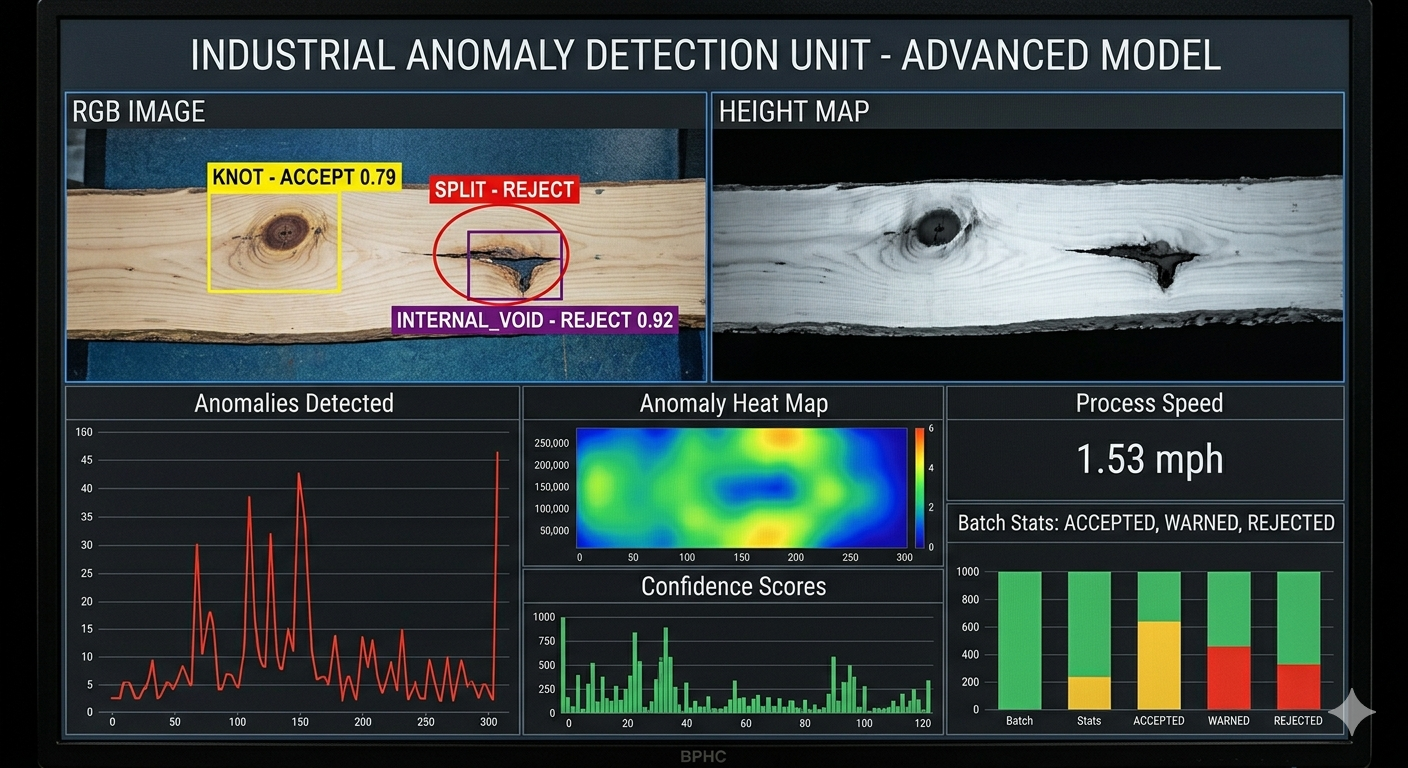
A Qualitas smart wood plank inspection system integrates laser profilometers for high-accuracy dimensional measurement, a multi-camera array with structured LED illumination for full-surface imaging, and a GPU-accelerated AI inference engine for defect classification and localisation — all operating inline at conveyor speed. Laser triangulation profilometers capture the full cross-section profile measuring length, width, and thickness continuously. Accuracy of ±0.1 mm is typical for production-grade sensors.
Line-scan or area-scan camera arrays capture high-resolution images of all inspectable plank surfaces. Structured LED illumination — combining raking light for surface texture defects and diffuse light for colour-contrast defects — ensures optimal visibility of both shallow surface defects (cracks, checks) and contrast defects (knots, stains, holes). Deep learning models (CNN-based) process each captured image frame in real time, with published research demonstrating mAP values above 95% for wood defect classification.
| Defect / Measurement Type | Detection Method | Model / Technique | Indicative Accuracy |
|---|---|---|---|
| Length / Width / Thickness | Laser triangulation profilometer | Geometric measurement | ±0.1 mm typical |
| Live knot | Camera + structured light | CNN classifier | ≥96% |
| Dead knot | Camera + texture analysis | CNN classifier | ≥95% |
| Crack / checking | Raking LED + edge detection | CNN + edge analysis | ≥94% |
| Hole / wormhole | Diffuse light + blob detection | DL detect | ≥97% |
| Damaged / chipped edge | Laser profile deviation | Profile analysis + CNN | ≥95% |
| Discolouration / stain | Colour camera + histogram | Rule-based + CNN | ≥93% |
| Warping / bow (flatness) | Laser profilometer profile | Geometric deviation | ±0.5 mm |
Expected Outcomes & ROI
| Outcome | Mechanism | Indicative Impact |
|---|---|---|
| Defect escape rate | 100% inline inspection vs sampled manual check | Reduction from ~25–30% miss rate to <2% |
| Yield improvement | Partial plank recovery: usable sections identified and marked | 3–8% yield gain on typical wood plank lines |
| Dimensional reject rate | Every plank measured; OOT planks caught before processing | Eliminates dimensional-related customer returns |
| Labour reduction | Manual grading station replaced by automated inspection | 2–4 FTE redeployment per production shift |
| Customer return rate | Consistent grading eliminates grade disputes and mismatch | 60–80% reduction in quality-related returns |
| OEE improvement | No line stoppages for manual inspection; continuous operation | +5–10% OEE on inspection-constrained lines |
| ROI payback | Labour savings + yield gain + return reduction | Typical 12–24 month payback period |
Implementation Considerations
A phased deployment is recommended: commencing with a site survey and requirements definition session to confirm conveyor speed and plank size range, number of faces to inspect, dimensional tolerance specifications, defect severity thresholds per grade, marking method preference (inkjet vs spray vs laser), and the PLC/SCADA interface for segregation.
A supervised pilot on one production line — running the system in parallel with manual inspection for an agreed validation period — builds statistical confidence in detection accuracy before the manual station is retired. Qualitas provides the acceptance test protocol, including the defect sample set and grading reference against which system performance is benchmarked.
The full application note covers detailed system architecture, camera and lighting configuration parameters, model training methodology, integration with existing MES and ERP systems, and a step-by-step deployment checklist validated across multiple production sites.