What needed solving
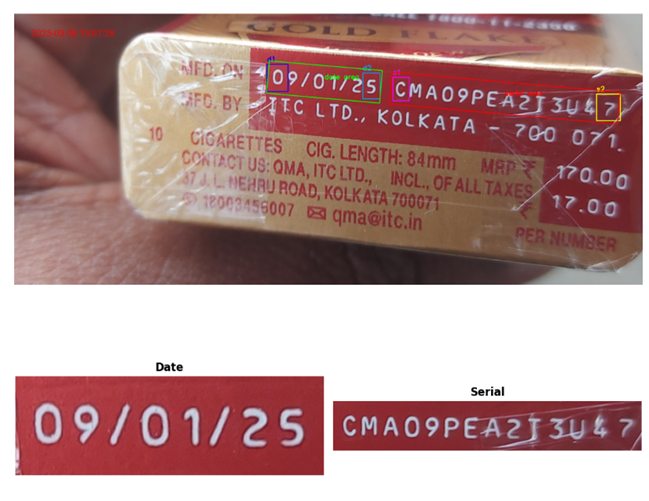
Human operators frequently misread characters on damaged or faded packaging, introducing unacceptable error rates. Field volunteers captured images under uncontrolled conditions — varying angles, orientations, lighting, and distances.
The manual process could not scale with growing data volumes, and inconsistent data quality compromised downstream regulatory compliance reporting.
How Qualitas solved it
A YOLO-based object detection model was trained on diverse real-world images to localize date and serial number text regions on cigarette packets, handling arbitrary orientations without requiring specific alignment.
Cropped text regions were processed by a PaddleOCR model fine-tuned for this domain and deployed as a web application — enabling field volunteers to upload images for real-time processing and verification with no specialist hardware required.
The full case study covers detailed system architecture, hardware configuration, algorithm pipeline, integration approach, validation data, and a step-by-step deployment timeline with ROI calculations from live production environments.